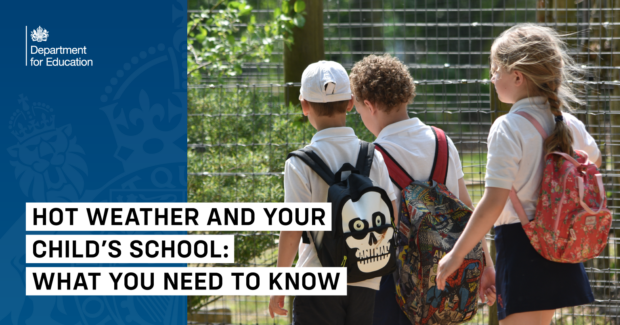
With higher temperatures, we know parents and carers can have questions about how schools are managing the heat and what it means for their child's day.
Schools are generally expected to remain fully open, with sensible adjustments made to reflect local conditions and the unique features of each school. Schools remaining open also helps families plan their days with confidence, which is why schools will generally keep their usual opening hours wherever it is safe to do so.
Why should I send my child to school?
Across the country, school leaders and staff will be taking practical steps to help children continue learning safely.
Children are often no cooler at home than they are in school, where trained staff can actively look out for them, make sure they're drinking enough water, and adapt the day as needed.
Going to school is about making the most of every moment of learning, and the benefit of routines, stability, support and social interaction that schools are uniquely placed to provide during periods of hot weather.
Your child's school day may look a little different during very warm weather, but it will still be a full and productive one. The aim is to adapt activities where necessary, rather than reduce the amount of time children spend in school. For most children, a hot day should still be a school day: with a few sensible adjustments, plenty of water, and the same focus on learning, safety and wellbeing.
Will schools close?
Just as schools adapt to wet weather and cold temperatures, hot weather can often be managed safely through practical measures. Parents should expect schools to operate broadly as normal, with head teachers making adaptations based on local conditions to keep children comfortable while maintaining a full school day wherever possible.
These adaptations might include:
- relaxing uniform requirements, so children can wear lighter, looser clothing. Parents may also be asked to send children with a refillable water bottle and a wide-brimmed sunhat, and to apply sunscreen before school.
- increasing access to drinking water
- moving lessons into cooler parts of the school
- using shaded outdoor spaces for learning
- rescheduling physical activity
- adjusting classroom layouts to improve airflow and ventilation.
What happens if a school closes?
If a school needs to close because conditions are unsafe, parents should expect some form of remote education where reasonably possible. This may include online lessons, recorded teaching, learning resources or independent work to complete at home.
Schools should communicate as early as possible and clearly about what will be provided, how pupils can access it and any support available. While remote learning cannot fully replace being in school, it can help minimise disruption during a temporary closure.
How do schools know when extra precautions are needed?
Schools should be monitoring guidance from the UK Health Security Agency (UKHSA) and the Met Office, including Heat-Health Alerts.
These alerts help education settings understand when conditions may pose greater risks and what additional actions may be appropriate for vulnerable children, staff and the wider school community.
School leaders can then make informed decisions based on local conditions, their buildings and the needs of their pupils.
What about children who are more vulnerable to heat?
Schools will be keeping a close eye on all pupils, particularly those who may be more at risk. If your child has a specific health condition that makes them particularly vulnerable in the heat, it's always worth speaking to the school directly so staff can make any additional adjustments needed.
You can find out more about symptoms of heat exhaustion and heatstroke illnesses on the NHS website. If you're ever concerned, NHS 111 can provide advice.